These blackberries come from the same farm from which we've been getting the peaches . . . right up there near my hometown.

What I did with them was nothing short of extraordinary. Over the last six months -- I have become fascinated with Shrub, an "artisan" beverage that supposedly has roots in Southern food traditions but also shares fundamental similarites with other "drinking vinegars" around the world. Back in late 2008, I first saw it referenced in
this article about a renaissance in drinking vinegars by some well-known bartender up in New York. He talks about the appealing flavor of shrub, its history (in particular, the drink gained cachet in the South during the temparance movement), and that of other drinking vinegars from around the world.
I was fascinated with the idea of something as exotic as a drinking vinegar that used to be a Southern staple. I filed it away in my head for later, talked up the possibility of dabbling in it with friends and family, etc. . . . but then we took Josephine on her first trip to Atlanta in early June, and while we were there, we ate at
Holeman and Finch ; sure enough, the bartender, who has received some accolades in his own right (e.g.
Food and Wine), was serving up Shrub.
One more sidenote: the guy from the aforementioned article references
Pok Pok, a modern Thai restaurant in Portland -- we went there a year ago, and both the restaurant and lots of other establishments in the city do an amazing job of crafting interesting homemade beverages -- many of the non-alcoholic sort. I hesitate to use the term "artisan" again b/c I think it's a vague to most people -- but it normally would be considered a good word to describe these drinks . . . homemade ginger ales and other non-traditional sodas, really creative fruit juices, etc. It's no secret -- you can find great stuff to drink in Portland.
So, when plenty of fruit started showing up at the farmer's market in June, along with some of my own watermelons nearing maturity in the backyard, I was convinced to start playing with my own versions of Shrub. It's very straightforward, so I've detailed a step by step oversimplification below. . .
I mashed them up in a small pot, the same pot in which I would eventually boil them.

But not until I first covered them with unfiltered apple cider vinegar . . .

. . . And then let them sit for a week in my upstairs office.
I put them up there while I was gone to Atlanta one week and I wrapped a rubber band around them b/c I had an almost-superstitious concern that this concoction might somehow explode while I was away. At the very least, I knew there was the risk that an unsuspecting wife might smell a foul odor coming from my office and wonder in there to inspect. I thought the rubber band might help contain the smell, and as an extra precaution, I left the recipe on top to let her know this was no accident -- something intentional was brewing. (Mind you, simply notifying her of this plan ahead of time would have led to unnecessary deliberations.)

I have to say, I was worried myself about the smell of leaving raw fruit to sit unrefrigerated in vinegar. But when I got back from Atlanta, the smell wasn't as bad as I was expecting . . . at the end of the week, it still just smelled like vinegar. Since then, I've manned subsequent batches seemlessly, so I now know that it never gets too wretched. (The strongest vinegar smell comes during the boiling stage).
The mixture does develop a film coating on the top, but otherwise, no unseemly growth.
Now, the recipe specifically recommends you stir the liquid once a day, but that wasn't a luxury I had since I was going to be gone for a few days and said wife was not disposed to cooperate in such an inspired experiment.
The next step was to add sugar and boil it. Here I had just drained it after boiling . . .
Then you let it cool, you add it to ice and sparkling water, and you're done.
Here you see the finished product . . . after adding a little shrub to the sparkling water, I stored some of it in small jars in the fridge. Although I didn't get a whole lot of shrub out of the one batch of blackberries, the potent, syrupy sweetness and sour acidity meant a little went a long way. (It only took 1-2 tablespoons to make this glass, but it wasn't quite as sweet as it needed to be, so maybe a pinch of extra sugar would've helped during boiling).

As for the flavor, blackberry is still my favorite (you can see other flavors I tried below.) In fact, even though it's really refreshing when added to the sparkling water, I enjoyed/appreciated it more when I sipped it straight. Drinking it straight reminded me a lot of a fruiter version of balsamic vinegar. It had a similar viscosity, and that same sharp nuttiness. (And I think I've heard they sip balsamic in certain parts of Italy.) Honestly, it made the Holeman and Finch shrub seem too drinkable, not nearly challenging enough; if I do say so myself, my blackberry shrub had more kick and more depth . . . and it was more earthy. It was like saying, "If you're going to like it, you're going to have to earn it."


As for the sparkling water dimension of the recipe, we conveniently have a home carbonator that I got for Jenny a few Christmases ago. (She had been drinking a lot of carbonated water from glass bottles, and although the home carbonator from Soda Club [since then rebranded as Sodastream] isn't cheap, it quickly pays for itself when you consider how quickly each bottle of water adds up.)
Let me briefly speak to the charms of sparkling water. The bite of the bubbles gives it more flavor and appeal than tap water, and nothing saws through thirst like sparkling water. At times it's so spiked that it's painful going down, but in doing so, it lords over a parched throat with an iron fist. And if you're regularly tempted by coke or other soft drinks, you may find that sparkling water is enough to avoid the sweeter, more indulgent alternatives. I've found it's usually the carbonation that I crave in coke just as much as anything; in fact, b/c we squeeze just about as much carbonation into our bottles as we can, I've been disappointed by a number of cokes I've had b/c the carbonation tastes much too weak now.
Not to mention you can add sparkling water to a variety of things, like juices, to wake them up a little bit. (The carbonator's warranty is voided if you carbonate anything other than water, but you can get a similar affect by simply mixing a strong juice with the sparkling water.) I'm reminded of a German drink my friend and I took to while in college. It was called something like Apfelsaft Gespritzt, at least that's what we called it in our comically (and intentionally) mangled German accents, and it was nothing more than carbonated apple juice. It was the best stuff, and I've never been able to find it in the US, but now I can make a rough facsimile at home.
Cross-referencing Portland for a moment -- we were eating at the
Clyde Common (the restaurant in the bottom of the Ace Hotel there), and I ordered their house Gin & Tonic, which is made with their homemade tonic water. I asked the waiter where they get quinine to make the tonic, and apparently, they get raw quinine bark and make it from that. It was really strong stuff, but if I ever get my hands on some raw quinine bark, I'm going to make my own tonic water too.
Here's the machine in action:
Okay, back to more shrub. This larger batch of blackberry shrub made more like a half-jar of shrub once strained . . .

.JPG)
Here are some materials for my the other shrubs. Pears and peaches from the farm near my hometown, a cantaulope from another farmer at the market, and watermelon from our yard .
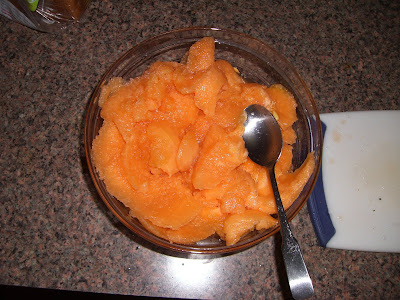
Here's the batch of cantaloupe shrub I made; it was one of my favorites b/c it had a smokiness to it.
Then there were the peaches . . . as I've said, I got these from a farm near my hometown. That part of the state is fairly well-known for peaches, and though it seems ironic in retrospect, some of the humble farms' fruit is now being showcased on swanky restaurant menus b/c of the trendiness of the local food movement.
These peaches were amazing -- at first they were too dry and unripe, but after a week while I was in Atlanta, they moistened up, the sweetness got concentrated, and streams of juice squirted out as a separated the flesh from the stone.
And the watermelon shrub I made in parallel . . .


Here is my shrub portfolio, which started out pretty limited (l-r, peach, cantaloupe, watermelon, blackberry) and has now diversified to include fig (w/ some blackberry in it) and pear, in addition to these first four flavors. See the second photo, 2-3 rows deep.

.JPG)
I depicted the process of making all but two of these -- the fig (foremost on the right) and the pear (second from left). The pear was good, but maybe b/c I wasn't selective enough in cutting the fruit from the core, it turned out kind of gritty. I'd say it's my least favorite of the lot. The fig worked out well, though. Mom brought a bumper crop from the fig tree in their backyard, and I mixed the crushed up figs with some residual blackberry mash I had leftover from a previous batch.
As you can imagine, even though all the fruit I use is locally-sourced, these recipes require me to go through quite a bit of cider vinegar. Jenny brought this beautiful, industrial size Bragg's bottle back from the store earlier this summer. I'm not sure why, but I think it's important that it's "With the mother." (On a tangent, I tend to categorize Mother Bragg's marketing strategy into a category with Dr. Bronner's Magic soaps. I don't really know who composes this market segment they're targeting with their labeling, but with a bizarre combination of hippy environmentalism, snake-oil consumerism, and God-fearing piety, it seems to be that sought-after demographic of pot-smoking Amish housewives who sit around watching Jimmy Swaggert and infomercials about natural foods all day.
In exchange for the vinegar jug, I paid $15 to check an extra bag full of Duke's mayonnaise on a trip home from Atlanta. (It turns out, the TSA counts mayo as fitting into the category of gels, liquids, and aerosols, and these clearly aren't in 5oz. containers.) That's a hefty tax for importing mayo, but Jenny insists on Duke's.

The summer was a good time for trying new drinks of all sorts. . . in addition to all my shrub experimentation, I made a few jars of aguas frescas (or I suppose it's more specific in this case: agua de sandia) . . . by mixing a little honey with fresh watermelon. You then dilute the base with water to get what's no more than flavored water; for us, I flavored sparkling water from our carbonator instead of water straight from the tap..JPG)
.JPG)
I also tried "making" michelada this summer, which was curious . . . and I think it could grow on me. By the sounds of it, the recipes/ingredients for michelada vary, but it's basically beer, lime juice, and hot sauce over ice -- sometimes Worcestershire sauce and tomato juice is involved. I didn't take any pictures, though, b/c there aren't really any unique ingredients that go into its creation.
In case you didn't click the link for the NYT article on drinking vinegars above, here's the recipe for shrub I promised . . . please try some yourself:
Recipe for Shrub
(Makes about 1 1/2 to 2 quarts, depending on fruit used; these measurements can be played with quite liberally, as some fruits contain more natural sugars.)
2 quarts fruit, use any fruit, pears, figs, raspberries, cherries
1 liter apple-cider vinegar (preferably Bragg) or other vinegar
1/2 to 1 cup raw sugar Soda water Ice
1. Rinse the fruit and discard any rot. Place in a large non-reactive or ceramic pot and mash for several minutes with your hands or a wooden spoon to break up. Pour in enough vinegar to cover and top with a lid. Let macerate at room temperature for a week, stirring once a day. (Do not be alarmed by the smell or the sludge on top.)
2. After a week, stir in 1/2 cup of the sugar and gently boil for 1 hour, stirring occasionally. Cool slightly, then strain. (The smell created from boiling is a bit offensive, so open the doors and windows.)
3. Make a test shrub: cool 3 to 4 tablespoons of the fruit mixture. Fill a 20-ounce glass with ice. Add water or soda water to almost the rim, then add the chilled fruit mixture. Taste to determine sweetness. If it is too tart, add sugar to the fruit mixture, little by little, while still hot. Cool fully and funnel into bottles. Will keep indefinitely in refrigerator.


 This is one of a few watermelons I got out of the garden this year -- very pleased with that result . . .


 I eventually cooked down a lot of the arugula b/c, strangely enough, Jenny prefers it that way -- I prefer it fresh in salads, but we end up with so much of it, you almost have to cook it down to deplete the supply . . .
 I don't really know why, but I also thought a "Cream of Arugula and Cucumber Soup" sounded like a good cold soup (a la Vichysoisse), or even a good warm soup for that matter. Not so. It was bad. It could've been something wrong with my execution, but I'm fairly uncertain about the original concept too. I've still got it in the freezer, though, in hopes that I can save it and make it into a sauce somehow. At the very least, it provides an extra layer of insulation in there -- so I guess it hasn't been totally useless.
 The herb bed loved the rain, and all the plants have really filled out their territory, but none more so than the oregano -- it's tyrannical. Overall, the herb bed's looking good, w/ less weed invasion than we've seen elsewhere,
 I'm a big fan of the purple basil -- it may seem understated, but since the herb garden is monochromatic for 90% of the year, it's a welcome diversion (I need to be more proactive about introducing some color here):
 As for myself, I was so smitten with persimmons this Summer that I tried as many things as I could think of. One of them was a persimmon interpretation of Limoncello (or some similarly fermented fruit concoction). I have to admit that a big part of my motivation was that I found the wordplay irresistible: "Persimmoncello." Why hasn't anyone thought of this yet? Maybe I'll find out once I take it out of my closet and finally try some.


.JPG)
.JPG)
.JPG)
.JPG)
.JPG) We also stopped at one or two wineries. Here, Josephine among the grapes at a winery just north of Boonville in the Anderson Valley, where the locals have their own dialect of English ("Boont" or "Boontling" -- look it up . . . )
We also stopped at one or two wineries. Here, Josephine among the grapes at a winery just north of Boonville in the Anderson Valley, where the locals have their own dialect of English ("Boont" or "Boontling" -- look it up . . . )
.JPG)
.JPG)
.JPG)
.JPG)


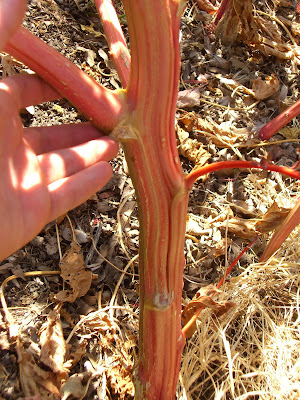
 The amaranth was about the only thing left, but even it was in its twilight.
.JPG)


.JPG)
.JPG)
.JPG)

.JPG)


